POLICY
On 22 April 2026, the Housing, Communities and Local Government Committee released their report, Housing Conditions in Temporary Accommodation, which finds that homeless families in England are being placed into unsafe properties, often with pest infestations.
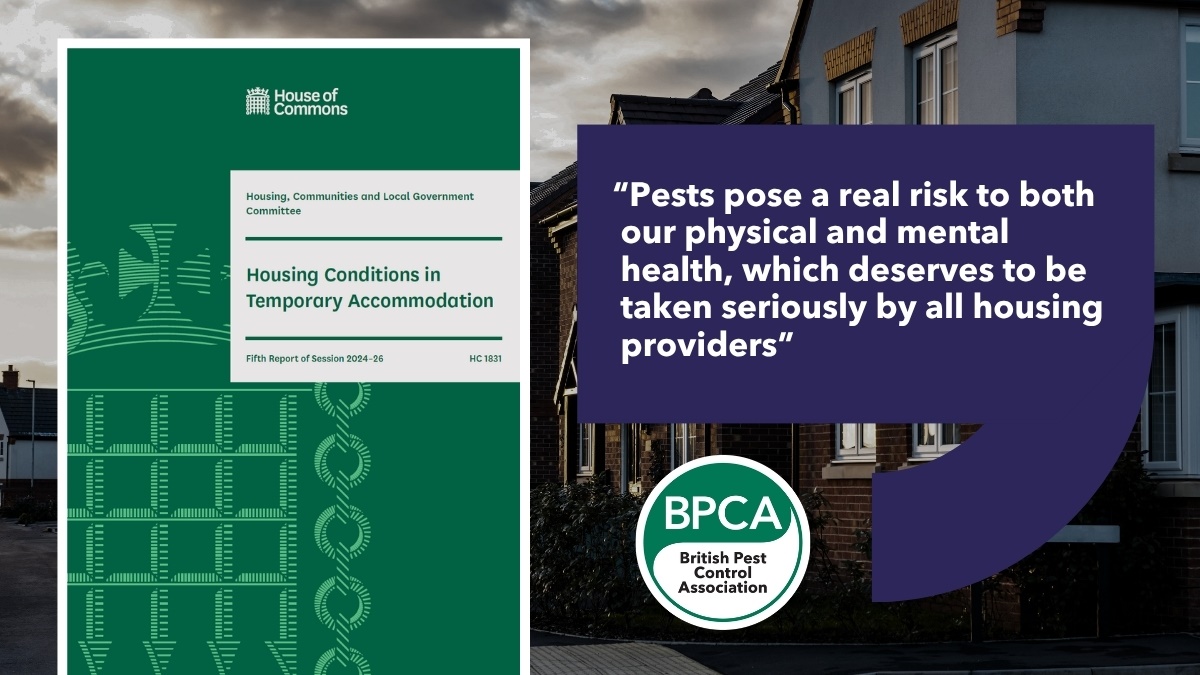
The Housing, Communities and Local Government Committee, as part of its inquiry into Housing Conditions in England, has reported on the state of temporary accommodation.
BPCA campaigns for everyone to live in homes that are safe from pest infestations and the disease, damage and misery pests can cause. One of our key asks of government is to recognise the invaluable role professional pest management plays in society. This report highlights exactly why that matters: pest professionals help make UK homes safer, healthier and fit to live in.
Rosina Robson, Chief Executive of British Pest Control Association (BPCA), said:
"We welcome the recommendations of the Committee and any actions that can deliver on making sure everyone lives in a safe home, free of pests.
“Pests pose a real risk to both our physical and mental health, which deserves to be taken seriously by all housing providers.
“We should not be allowing anyone, let alone the most vulnerable in our society, to live in such conditions, no matter how 'temporary'".
The committee is made up of MPs from across the House of Commons and is responsible for scrutinising the government's work.
The report found that “Infestations of rats, mice, cockroaches and other pests are… common” in temporary accommodation.
“We have heard of a child who was bitten on the toe by a rat during the night and another who suffered from sleep deprivation after waking up covered in ants. The Justlife Foundation, a charity, provided us with feedback from a frontline worker who observed someone living in temporary accommodation with red dots on their legs, where they had been bitten.”
What is temporary accommodation?
Temporary accommodation refers to accommodation provided by local authorities to households experiencing homelessness. This can range from their own social housing stock to hotels, hostels, and bed-and-breakfasts.
As of September 2025, 134,760 households, which included 175,990 children, were living in temporary accommodation in England.
There is no requirement on local authorities to inspect the temporary accommodation before families are moved in. Once they are moved in, they lack legal protection against these poor conditions, occupying the property under a license rather than as tenants.
The report found that people are “reluctant to complain about poor conditions out of fear they could be moved elsewhere or deemed intentionally homeless”, which could mean being asked to leave without further support, or that they will “be poorly treated or penalised for doing so.” The Committee heard evidence that these fears had been made real.
Awaab’s Law, which applies to social housing, the first phase of which came into force last year and covers the most serious risks, does not apply to temporary accommodation. The government has committed to extending Awaab’s Law to temporary accommodation but is waiting to consult on the best way to do so.
The Committee has called on the government to implement a phased rollout of Awaab’s Law to temporary accommodation, and for it to be fully applied by the end of 2028/29.
The new Decent Homes Standard, which should also offer protection from the most hazards, will also not apply to temporary accommodation until 2035.
The Committee has called for interim targets for the Decent Homes Standard to be set for temporary accommodation, to ensure compliance in time.
BPCA's role in getting pest management onto the national agenda
BPCA supports raising standards in housing of all types and is key to protecting public health; it should not matter where your home is or who owns it: the risks posed by pests are the same.
Alongside the inquiry, BPCA contacted members of the Housing Committee directly to offer briefings on current challenges facing the sector, and one followed up with a MP visit to a member.
BPCA has also issued two new manifestos, calling upon parties and candidates standing in the upcoming Welsh and Scottish elections to improve standards and ensure that those in temporary accommodation are protected.
We have also recently submitted recommendations to Northern Ireland’s Department for Communities to ensure that the update to their Decent Homes Standard includes real protections against pests.