PPC124 | BUSINESS
Artificial intelligence can write your emails, tidy your reports, plan your marketing and... invent an entirely new species of rat.
Used well, AI can save pest professionals a serious amount of time and improve customer communication. Used badly, it can produce convincing nonsense, flatten your personality and turn dodgy technical information into something that looks worryingly authoritative.
SJ Scott Johnstone BPCA Technology Manager
AW Alex Wade Wade Environmental
VH Vicki Hall Lady Bug Pest Control
The good, the bad and the completely made-up
PPC This conversation started because BPCA’s Outreach and Communications group got a tiny bit grumpy about some of the AI content we were seeing in pest management.
Professional Standards had a similar conversation in one of their meetings. So, nice easy opener. What’s the worst use of AI you’ve ever seen?
AW Technical marketing posts. You’ll see one saying “know your pest”, and it looks convincing, but the information just isn’t right.
I saw one with the brown rat, black rat, house mouse and then a fourth commensal rodent species that didn’t exist. I traced it back to what looked like a misspelling on one website. The AI had effectively invented a rodent, but the pictures looked good enough that somebody who didn’t know better would accept it.
VH The thing that gets me is how everything starts to look the same. Pest control posters, village fair posters, restaurant meal-of-the-day posters. You can almost always see the prompt behind them.
AW There’s nothing wrong with using generative AI to do something you can’t easily do yourself. The problem is blindly trusting what it gives you. Check it, and if something looks squiffy, ask somebody who knows.
PPC There is definitely a “ChatGPT look”. Pest images are a particular bugbear of mine too. AI can produce a convincing photograph of something that’s half bed bug, half woodlouse and entirely fictional. If search results fill up with plausible-looking rubbish, identification gets harder.
VH We already get customers saying they’ve identified something themselves from Google Images. I’ll still ask them to send me an actual photograph of the actual insect. I need to see it myself.
PPC And that gets harder when some of the reference images appearing in search results are AI-generated rubbish.
AW There was a similar thing online with baby peacocks. AI images spread because people hadn’t really seen one and the pictures looked plausible. A baby peacock, in reality, just looks like a bloody bird.
Using AI when you know the answer
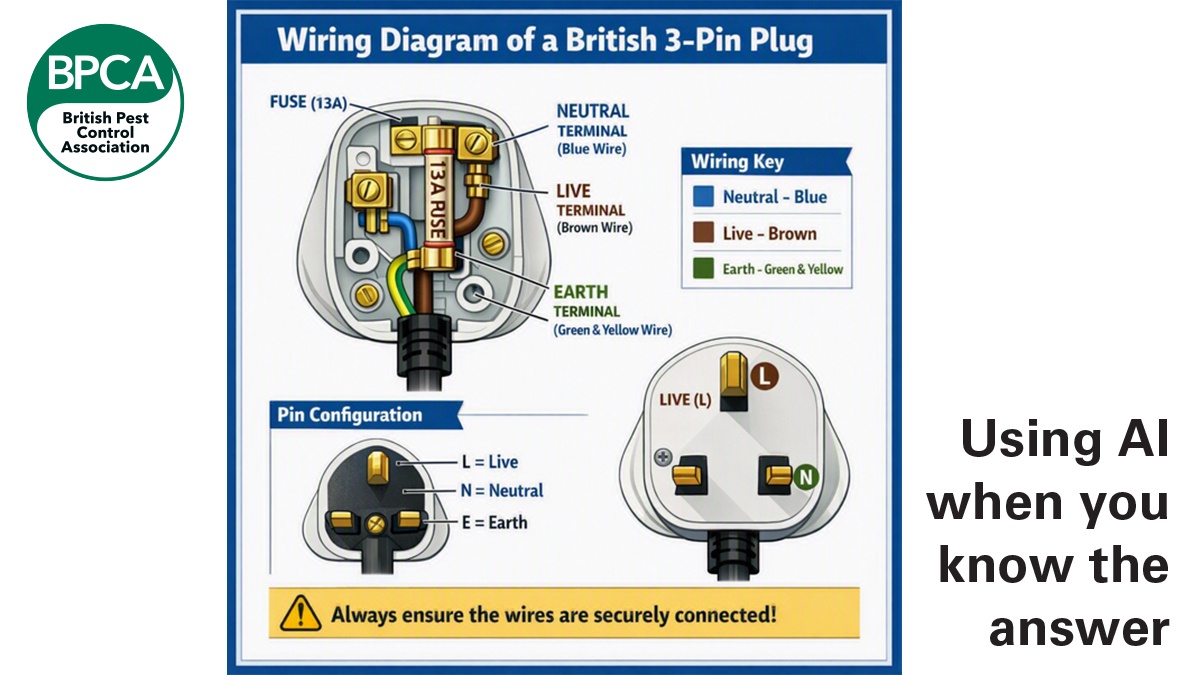
Alex demonstrated this by asking an AI image tool for a wiring diagram of a British three-
pin plug. It confidently produced a diagram
with connections and components in the
wrong places.
PPC That gives us one of the biggest rules. If you don’t know roughly what the right answer should look like, AI is a dangerous way to fill the gap.
AW That sort of thing could actually hurt someone. With pest content, the consequences may be different, but the principle is the same.
PPC Vicki can use AI to improve a treatment report because she already knows how to write one. I couldn’t ask it to produce one and assume it was right because I don’t have her practical knowledge.
VH I use it a lot for reports, but it doesn’t write the report for me. I know what I want to say, and it helps make it more fully bodied or professional. Then I check it before it goes to the client. It saves me a hell of a lot of time, even with the checking.
Sometimes it uses one of Alex’s big words, and I’m sitting there thinking, “What the hell does that mean?”
AW All words are made up at the end of the day. That’s the joy of them.
There’s another issue here around client confidentiality. If you’re putting treatment information into an AI system, that might include somebody’s name, address, the fact they’ve got pests and other information about them.
PPC If you’re using it with client information, think about confidentiality and data protection. Don’t paste names, addresses, treatment details or other identifiable information into an AI system unless your organisation has approved that use and you understand how the service handles the data.
AI is a signpost, not an expert
VH I’ve also used ChatGPT while planning a new business in an industry I didn’t know much about. Without it, I genuinely wouldn’t have known where to start.
But I’ve done the background research and spoken to real people in that industry. If ChatGPT tells me X, Y and Z, I go to an expert and ask whether X, Y and Z are actually true.
PPC I like that use. AI can help map out what you need to learn and who you need to speak to. The dangerous bit is mistaking signposting for expertise.
We’ve seen the same problem with references. I once received a technical article for PPC magazine that cited a Clive Boase article about wasps on waste sites, supposedly published in PPC in 2017.
It sounded plausible. Clive is a real consultant member and had written on a similar subject. But I edited PPC in 2017, and that article never existed. The reference and quote were made up.
AW I get that when I’m looking for research. Sometimes AI finds exactly the scientific paper I need. Other times it says, “Yes, you’re absolutely right, here’s the paper that proves it.”
Then you click through and discover it doesn’t exist. It wants to please you.
Keeping your own voice
PPC I’ve written something to someone important, wondered whether the tone was right, put it through AI to calm it down and then thought, “That doesn’t sound like me at all.”
At some point you have to ask whether polishing away your personality makes the communication better.
AW AI writing has patterns. It likes certain words and structures. It can be grammatically fine but still feel slightly off.
PPC Which is awkward for copywriters. Rules of three, active voice, alliteration, subheadings and bullet lists used to be called good writing. Now half of them make people shout, “ChatGPT!”
VH AI has its place, the same as social media has good and bad uses. It has helped me a hell of a lot. People just need to check what it actually gives them.
AW And if you’re going to use AI to put yourself on a pedestal of technical excellence, make sure you can back your BS up in the real world. It’s no good saying “we are the best at insect identification” if the technician arriving on site can’t tell the pests apart.
PPC My final test is simple. AI can make you a bit superhuman. It can help you work quicker and get better at something you already understand. Or it can make you less human, less approachable and worse at your job.
Before you publish the output, ask which one it’s doing.
AI dos and don’ts for pest professionals
DO
- Use AI to speed up work you already understand
- Check every technical claim before it reaches a client or the public
- Follow references back to the original source and make sure they exist
- Use trusted technical guides, real photographs and experienced people for pest identification
- Check data protection rules and the AI provider’s terms before entering client information
- Give clear instructions about audience, tone, purpose and boundaries
- Rewrite the output until it sounds like you
- Ask a real expert when the subject goes beyond your competence.
DON’T
- Use AI as a substitute for pest management knowledge or practical pest control training
- Assume a realistic-looking pest image is biologically accurate
- Copy technical advice into a report, article or social post without checking it
- Trust a citation just because it looks convincing
- Upload confidential or personally identifiable information without understanding how it will be processed
- Let generic AI copy flatten your company’s personality
- Claim expertise in marketing that your team can’t demonstrate on site
- Forget that responsibility for what you publish, recommend or send to a client is still yours.
Can AI identify your pest? PestOrNot.com
One of the trickier uses of AI is pest identification. A blurry phone photo, an unusual life stage or a suspicious dropping can all send a standard image recognition tool confidently off in the wrong direction.
PestOrNot is trying a slightly different approach. Users upload a photograph of a pest, droppings, damage, nests or other evidence. The tool checks image quality, uses AI to analyse what it can see, then validates the result against PestOrNot’s structured pest and evidence database before providing supporting information and suggested next steps.
Importantly, it doesn’t always try to force a species-level identification. Where the evidence isn’t strong enough, it can return a broader or uncertain result instead.
PestOrNot says the tool currently achieves 94.7% accuracy on its internal test set, although it stresses this is a benchmark rather than a guarantee for every photograph.
It’s not designed to replace a pest professional or entomologist. But as a first-pass identification tool, particularly for customers trying to work out whether they’ve got a pest problem, it’s an interesting example of AI being used with a few sensible guardrails attached. Try it for free at pestornot.com