PPC124 | TECHNICAL
Jordan Padley of Precision Pest Management shares his practical approach to tackling mice in food factories. As a special guest speaker at BPCA’s Young Professional Digital Forum, Jordan talked about risk, strategy, and the art of working with clients to keep products, people and reputations safe.

When people hear “food factory,” they often imagine a super-clean, well-sealed building where a mouse wouldn’t stand a chance. The reality? It’s a bit like a restaurant - only bigger, busier, and with far more to think about when you’re inspecting, proofing, or treating.
I work mainly in Nottinghamshire, South Yorkshire and Derbyshire, and most of my calls to food factories fall into two camps: the “we’ve seen one mouse” panic, and the “it’s been going on for a while” crisis. Both can be just as tricky.
Why one mouse can be a big problem
The risks to the factory are huge, even with a single rodent. The risks to the factory are huge, even with a single rodent, from reputational damage to enormous financial ramifications. And if contamination hits the product, it’s not just about replacing stock; it’s recalls, damaged relationships, potential business loss, and a very unhappy client pointing the finger at you.
There’s the obvious disease transmission risk from droppings or urine, but also:
- Damage to packaging
- Chewed electrical cabling
- Harm to equipment worth millions
- Knock-on effects for visiting contractors, auditors, and the workforce.
And if an auditor finds evidence you’ve missed, you’re in for some painful follow-up requirements.
The first call-out
Let’s say it’s 7:30am and I get the call. Before I’ve even picked up a torch, I’m thinking: where is the problem?
- Is it near raw ingredients?
- In the mixing area?
- At packaging?
- Or right at dispatch?
That dictates how serious the risk is and what options we’ve got. Then I start thinking about harbourage. Is it a 120-year-old factory full of nooks and crannies, or a shiny new build where the only hiding place is under a pallet? Sometimes you can’t find a gap anywhere, which makes you wonder if the mouse is tucked away inside machinery or just nipping in through a loading bay.
It’s worth trying to work out how long the rodent has been around. Some factories are proactive, checking bait boxes daily, while others only do the minimum their auditor requires. A mouse that’s been around a while will be more comfortable, and possibly harder to catch.
And I always assess hygiene. Is food debris cleared instantly, or are you forever reporting spillages that stay put until the next shift? The cleaner the site, the fewer easy meals for a mouse.
But my number one consideration? Protect the product. That’s what the client cares about most and it’s what keeps the contract alive.
Thinking in three dimensions
Mice don’t just walk along floors. They climb, run along cables, hide in wall cavities and use overhead gantries like motorways.
Older factories are often a patchwork of extensions, each creating more voids and cavities. I’ve seen mice and even stored product insects breeding happily out of sight in these spaces. That’s when tracking powders and gels become essential. Personally, I’m a fan of fluorescent types – they’re easier to demonstrate to the client, and you can still see fragments even if cleaning teams have been through.
Doors are another giveaway. A dispatch area with a manual roller door that’s left ajar? You might be chasing a visitor from outside rather than a resident population.
And don’t forget the rules. Different clients have different specifications: BRC, Tesco, M&S, and Morrisons. Each has its own audit quirks. Make sure every control you put in is compliant with their standard as well as the law.
Adapting your plan
Every site (and every infestation) is different. I’ve worked on satellite offices well away from food production, where the mice were travelling above ceiling voids. Bait boxes on the floor were useless; instead, we used traps and contact gels placed where they were actually moving.
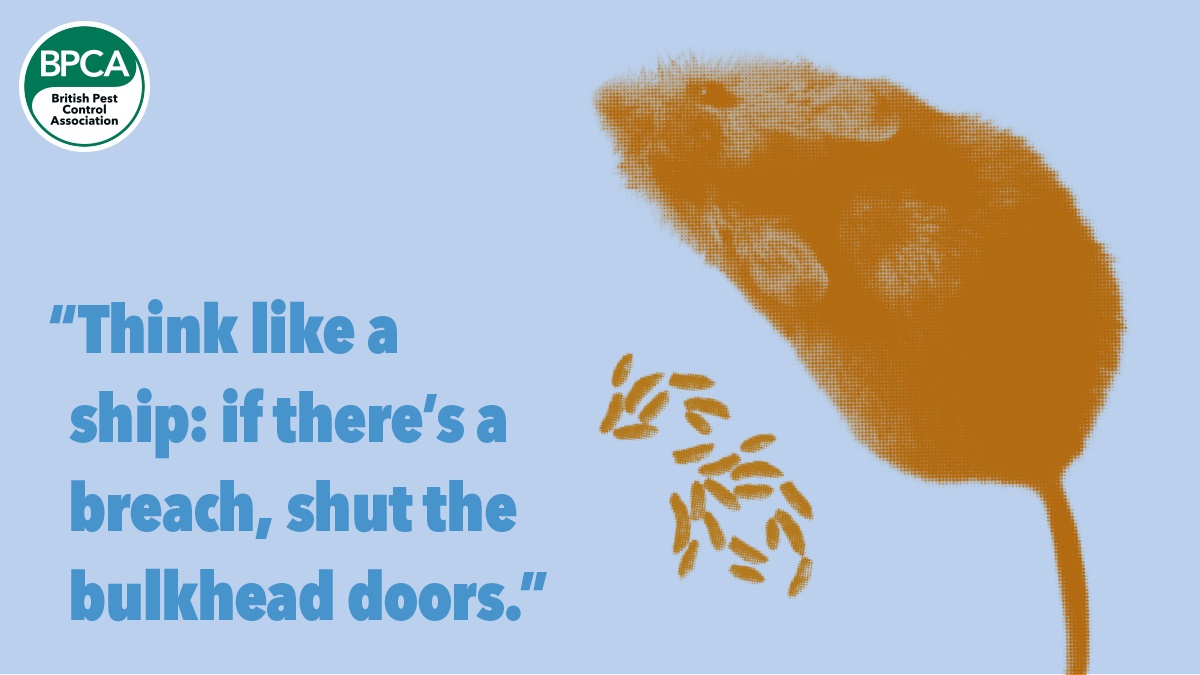
Sometimes you can’t exclude them from the whole site, but you can isolate an area. Think like a ship: if there’s a breach, shut the bulkhead doors. If it’s in the warehouse, keep it from getting to production.
Restriction is next. Can you remove or relocate food and water sources? Easier said than done in a wet-cleaning production area, but in a warehouse, it’s more realistic.
Finally comes destruction – physical or chemical control. Traps are my go-to, but if rodenticides are necessary, you may need dispensation from the client’s customer. Always get approval, and always take the pesticide to the pest, using the right formulation for the area.
Tracking and tech
I always use tracking powders and gels, so I know what’s been happening between visits. I leave them – and any non-toxic controls – in place until the next routine. That way if we’ve missed something, we’ve got four weeks of extra monitoring.
Cameras can be a great add-on if the client allows it. They give you visual proof of where the mouse is going and can make your treatment plan far more targeted.
Know your pest and your client
Mice are sporadic feeders, and increasingly I’m seeing box shyness. They’ll exploit small cracks, travel through electrical infrastructure, and follow old scent trails, sometimes years after the original infestation.
Their breeding cycle can be as short as three weeks in warm, food-rich conditions, so you’ve got to move quickly.
But in a food factory, you can’t do much without client cooperation. Many sites have pest-awareness trained staff, and some even have BPCA/RSPH Level 2 trained team members who can check monitors between my visits. That day-to-day input is gold.
I’ll speak to hygiene teams, technical managers, quality staff, whoever’s my point of contact, and get them involved. I’ll also work with them to change things up: different trap styles, moving positions, drilling into wall cavities to place controls. You’ve got to be flexible.
Follow-ups and modifications
Follow-up frequency should be based on risk. In a high-risk open-food area, I’d be back at least every other day until it’s clear. In a warehouse, two to three times a week might be enough. And between visits, I want the site staff looking for signs daily.
Every infestation is also a test of your integrated pest management (IPM). If the mouse got past your existing controls, it’s worth reviewing:
- Do you need to change trap or box types?
- Move positions?
- Add attractants?
- Increase proofing?
Sometimes it’s worth suggesting extra services like dedicated proofing inspections or hygiene deep-cleans. Clients tend to be most receptive to these ideas when they’ve got a problem in front of them.
SHARE YOUR CASE STUDIES
Got a story, tip, or case study to share with your fellow BPCA members? Whether it’s a tricky job you cracked, a clever control method, or a lesson learned the hard way, PPC magazine wants to hear from you. hello@bpca.org.uk