PESTAWARE
Sightings of Yellow-legged (Asian) hornets in Derbyshire and Nottinghamshire have prompted a call for householders in the East Midlands to keep an eye out for ‘things that go buzz’ this summer.
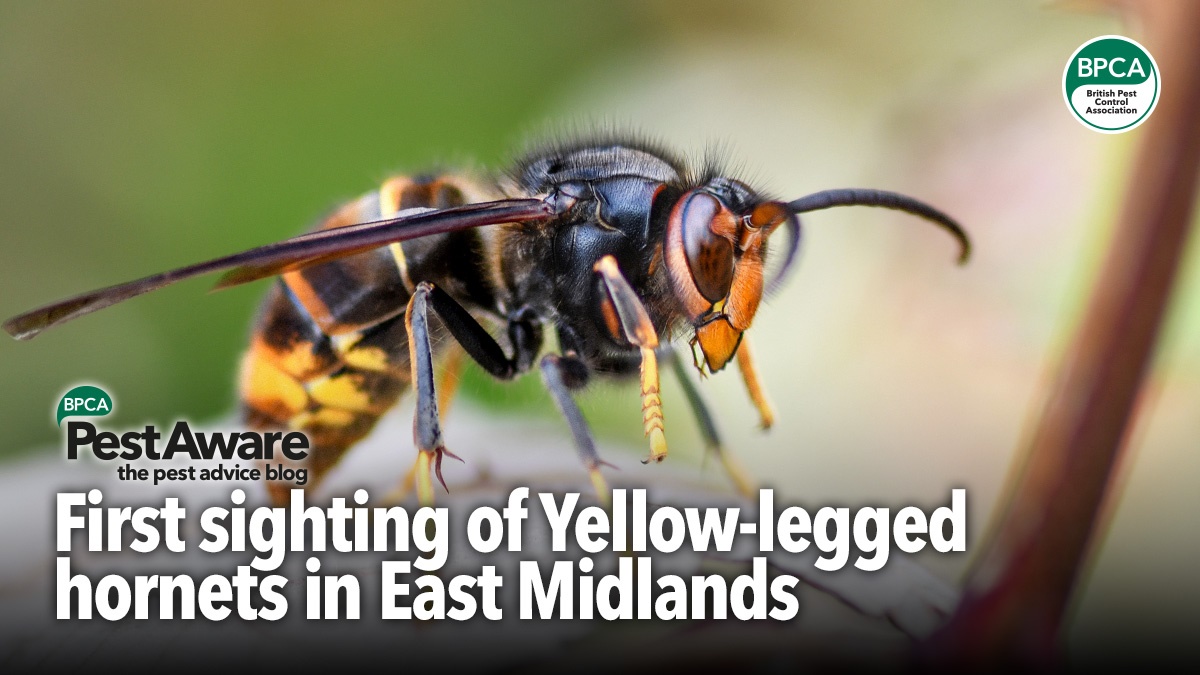
National trade body British Pest Control Association (BPCA) has reiterated the importance of correct identification to help prevent the spread of Yellow-legged hornets, which are a classed as an invasive ‘alert’ species by the Non-Native Species Secretariat and which pose a significant risk to native ecosystems, particularly honeybees.
Yellow-legged hornets were spotted for the first time in the East Midlands in April.
An embryo nest was discovered in Chesterfield on April 26. Insects were intercepted at Repton in South Derbyshire and Rushcliffe in Nottinghamshire the following day, according to the National Bee Unit¹.
The first UK sighting of a Yellow-legged hornet in 2026 was at Doncaster in February followed by a report in Sawtry, Cambridgeshire in March.
Other reports in April included six in Kent, two in Hampshire, and one in Surrey. Three further sightings have been recorded in Kent so far in May.
Niall Gallagher, Technical Manager at British Pest Control Association (BPCA), said: “The Yellow-legged hornet is an invader that was first reported in the UK in 2016.
“It is a predator of honeybees which could disrupt our native ecosystems and impact crop production.
“To the untrained eye, it can be difficult to tell the difference between bees, wasps, native Europeans hornets and Yellow-legged hornets, but accurate identification is crucial to understanding and preventing the spread of this invasive species.
“The Yellow-legged hornet is smaller than our native species. It has an orange head, and its entire body is almost entirely dark.
“The abdomen has fine yellow stripes and a yellow or orange segment near the base. Their legs are dark and have yellow tips.”
Native European hornets are larger than Yellow-legged hornets at 3-4cm long, with a yellow head at the front, a reddish brown or black thorax and legs and a yellow abdomen with black stripes.
They are important pollinators and are generally less aggressive than wasps, despite being much larger and scarier looking, however they will sting defensively if they believe the nest is under threat.
Like bees and wasps, hornet stings can be very painful and may result in red swelling and a burning sensation.
In rare cases a sting can trigger anaphylaxis which can be fatal. If anaphylactic shock is suspected, always dial 999.
In the event that a nest is found in a location which poses a risk to people, BPCA recommends contacting one of its members, who will have the knowledge, experience and kit needed to deal with the problem safely.
BPCA has an online factsheet that can help householders in identifying ‘things that go buzz’.
Niall added: “There are many different types of wasps, bees and hoverflies that are not classed as pests and are unlikely to pose a risk to health. Some species that are considered pests, such as common wasps, can be safely left alone if they are in an area where they are unlikely to come into conflict with people.
“Buzzing insects tend to be more active during warm weather and for peace of mind, our guide will help residents identify whether insects can be left to safely pollinate garden flowers or whether you may need to call on the services of a pest professional.
“Any sightings of Yellow-legged hornets should be reported to the Non-Native Species Secretariat either via their website, which also features identification information, or via the Asian Hornet Watch app.”
To find out more about ‘things that go buzz’, visit bpca.org.uk/buzz.
BPCA member businesses are endorsed by the Government via the TrustMark quality scheme as they must carry the correct insurances and are trained and qualified technicians who are assessed to the British Standard in pest management EN 16636 and follow BPCA’s Codes of Best Practice.
To find a BPCA member visit: bpca.org.uk/find.
1. https://www.nationalbeeunit.com/about-us/beekeeping-news/yellow-legged-hornet-2025-rolling-update-2#