PPC123 | TECHNICAL
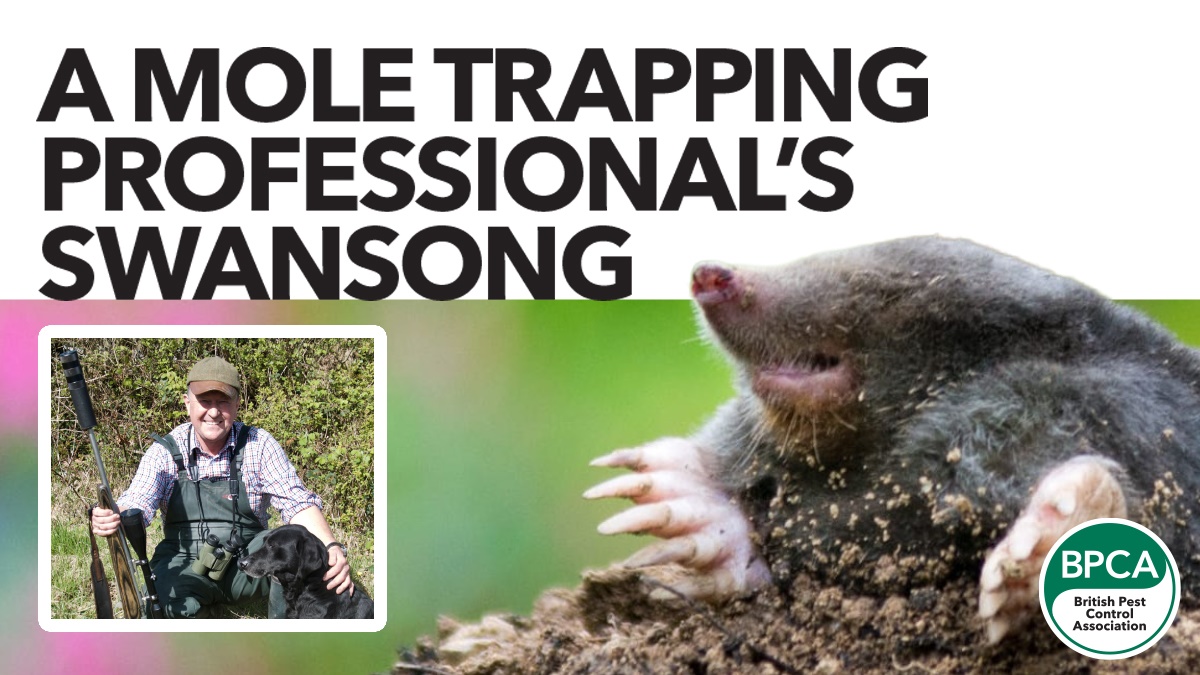
Dave Archer, DKA Training, has been catching moles professionally for almost five decades. Working with scientists from Plymouth University and University of Exeter, Dave has helped develop a new type of mole trap. Here he shares his thoughts on humane capture, mole trap design and the Archer Adjustment.
I have been catching moles professionally for well over forty-five years and whilst we as an industry are increasingly concerned about animal welfare in general, it seems that moles in particular have never been afforded such privilege.
From post-war times, the cast iron scissor trap was the most widely available trap, and as designs changed, so did the efficacy of the trap. Modern versions are made using galvanised or stainless steel, and the Fenn mole trap takes the design one stage further and is far removed from the original design.
In the last fifty or so years, many different design of traps have entered the market – which goes to show the ingenuity of inventors, and perhaps the perceived difficulty in the art of trapping moles!
However, if you become proficient in mole trapping, the techniques used in deploying the traps are essentially similar; ergo if you can catch with one design, you can probably catch with most mole trap designs.
Welfare considerations
But being able to catch a mole is only part of the overall picture. We must also be as humane in our trapping campaigns as possible. Legislation in mole trapping has largely gone over the moles head, which I find incredible for this day and age.
Mole traps are not included in the Spring Traps Approval Order (STAO). There is no statutory timescale for checking of mole traps, only recommendations.
Even so-called ‘humane catch alive’ mole traps, available from many garden centres, may possibly be the cruellest traps available today. Once the mole enters the tube it often dies a lingering death in a plastic coffin. Ref. Baker and McDonald 2012.
The scissor and Putange style traps nearly always give a clean kill, despite what others have stated about their performance. I state “nearly,” as no trap is ever one hundred percent effective.
Unlike many, I had huge reservations regarding the Duffus or half barrel trap – and still do. Improvements in the manufacturing process, (using stainless steel half-barrels and springs), may have improved the mechanics of the operation, but the strike bar is still left in the original design’s position.
My main objection to this is that the trap’s catch bar often hits the mole in the midriff, and the mole dangles upside down to die a lingering death. Those that state the answer was to bend and manipulate the trap wires were, I felt, missing the point two-fold.
Firstly, if any trap has to be modified by the end user before being deployed, there is a fundamental design flaw.
Secondly, even bent and modified wires can be pushed back into the original position by a mole before the trap is sprung, making the adjustments ineffective, as the catch bar was still hitting the mole in the midriff as opposed to the vital organs.
Doing the research
Of course, there are many who would state that one man’s opinions are perhaps unreliable and based on personal bias. I have no qualms with this; however, Oxford University’s scientists were advertising far and wide in 2017 for any mole trappers to assist in a scientific research study into the efficiency of mole traps, in particular half-barrel and Putange style types.
I was delighted that scientific research could now perhaps validate my personal observations. As far as I am aware, I was the only mole trapper to reply to their request, and after an initial meeting, I then sent numerous samples and photographs of trapped moles for the scientists to evaluate the individual traps performance.
The results concluded that half-barrel traps in particular have flaws compared to other designs.
Armed with this information, I contacted all of the major suppliers and manufacturers, to ascertain their willingness to change design. Sadly, not one company gave the idea any merit.
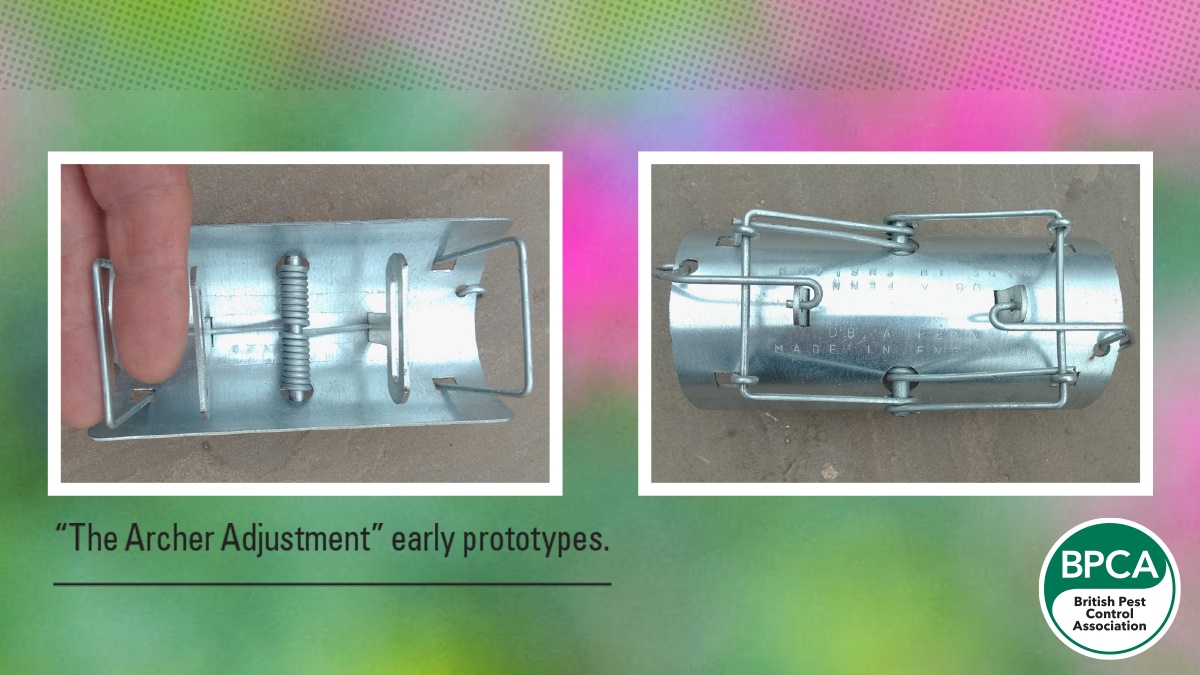
Not to be thwarted, I therefore adapted a Duffus trap myself and tested it in the field and not only did it work, but it killed cleanly every time because the mumble pin and catch bar were now closer together, and hitting in the vital organ area. I then took my modified trap to D B Springs in Astwood Bank (the original A. Fenn works,) to consider the new design.
After many meetings, and based on the proven effectiveness of my adjustment, the owner then came back with a different modification that is not only easier to set, but in field trials it strikes in the vital organs without any trap adjustment.
I am now working with University of Exeter to further investigate mole traps from a scientific basis. This new design will be included in the research.
I called the invention the “Archer Adjustment”; it’s my swansong to a lifetime’s career, and if you care about mole welfare, I urge you to give this new design a go. If not for your conscience, then certainly for the little gentleman in black velvet’s welfare!
A research project is currently being undertaken into mole control by two scientists at the University of Exeter.
A three-year research project, led by Dr Sarah Crowley and Dr Jules Dezeure at the Penryn campus in Cornwall, seeks to better understand how European moles are perceived and managed in practice.
Dr Dezeure said, “While moles are widespread across the UK, little research exists on current approaches to management, how well these are working, and what alternatives could be viable.
“As part of the project, we are conducting interviews with land and wildlife management professionals, including pest controllers and farmers, to explore perceptions of moles, motivations for management, practical challenges, and views on various techniques. Your expertise and insights are invaluable to this work.”
If you are interested in collaborating or sharing your experiences, or have any questions about the research, please contact Dr Dezeure at j.l.f.dezeure@exeter.ac.uk. Your participation will help inform future policy, guidance, and wildlife management practices.
Dave added, “If you are involved in practical mole control, this is your chance to actively contribute to the future of mole welfare: don’t bury your head in the soil, get involved!”
Defra pledges to look at mole traps
Over Christmas, the Government launched its Animal Welfare Strategy, which included a commitment to review mole traps. Mole traps are completely unregulated in England and Wales under The Small Ground Vermin Traps Order 1958, and in Scotland under equivalent legislation.
They don’t appear on the Spring Trap Approvals Order; they don’t go through any approvals process.
So in March, we asked you for your views and experiences with mole trapping. The results confirmed real welfare concerns, with the market full of cheap imitations and knock-offs.
Professionals know what makes a good mole trap, and our Code of Best Practice reinforces that. But the public doesn’t know what makes a good mole trap, and these poor-quality traps are available online and in garden centres around the country.
Even if a member of the general public was able to choose a good trap, they wouldn’t have the experience necessary to use it effectively or humanely. The survey results showed just how specialised mole control was, with over a third having more than 20 years of experience, and three-quarters having more than 5 years.
Your feedback also confirmed that there was no alternative to trapping: there are no chemical repellents, deterrents don’t work, and aluminium phosphide is unpopular and cannot be used everywhere.
Based on your feedback, if the government decides to act following its review, BPCA could support adding mole traps to the Spring Trap Approval Orders for England and Wales. This would be conditional on manufacturers being actively supported through the approvals process, and there not being any point at which we have no approved traps.
We believe that such a change would ensure that the best traps already used by professionals remain available, while clamping down on the public's use of poor-quality traps.
Send your thoughts to policy@bpca.org.uk