PPC123 | TECHNICAL
Destroying a nest with insecticide will often be the right option, but should it always be the automatic first step? Proofing, good housekeeping, landscape management, monitoring, light traps and even manual nest removal can all reduce reliance on pesticides. This guidance sets out practical methods for UK pest professionals, drawing on international best practice where relevant.
With increasing restrictions on the professional pest management toolkit, BPCA Technical and Compliance Manager, Niall Gallagher, looks at effective wasp control and ideas that protect people, animals and ecosystems.
Speed read
- Seal gaps and proof buildings – queens can exploit spaces as small as 3 mm
- Keep bins clean, lids shut, and recyclables rinsed to cut food sources
- Manage planting and aphids around entrances to reduce attraction
- Use traps to monitor pressure: protein lures in spring, sugary baits in summer
- Only use HSE-approved insecticides when necessary – consider non-chemical first.
Exclusion and housekeeping
Proofing and physical barriers
The most sustainable way to manage wasps is to keep them out in the first place. Even very small gaps are enough for queens to find their way into a structure. As a guide, anything over 3 mm should be sealed. This means paying attention to common ingress points such as cable entry holes, vents, roof spaces and pipework. Durable, weather-resistant sealants and fillers are essential.
In some settings, particularly food production, healthcare or education, insect mesh is highly effective. A mesh aperture of less than 2 mm is recommended for windows, vents and doors. Screens should be removable for cleaning and comply with hygiene standards.
On sites with high footfall, such as shops or hospitals, pest professionals can also consider air curtains or automatic closers. These reduce the number of opportunities for wasps to enter when doors are propped open.
Housekeeping standards
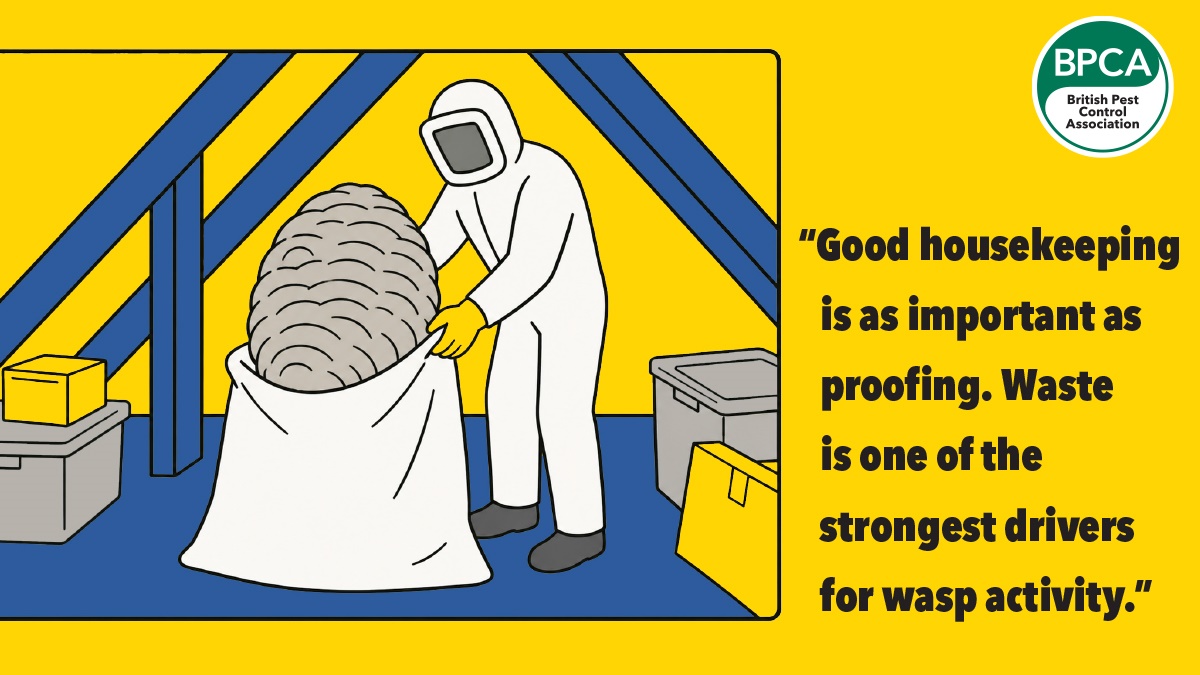
Good housekeeping is as important as proofing. Waste is one of the strongest drivers for wasp activity, so bins must be emptied regularly, lids should be kept closed, and containers washed down to remove residues. During the height of summer, this may need to be done daily.
Composting, if it takes place on site, should be confined to sealed systems.
Recycling must also be managed carefully. Bottles, cans and food packaging should always be rinsed before being placed outside.
Sticky residues, even in small quantities, will attract large numbers of wasps.
Food businesses such as bakeries, kitchens and cafés should adopt strict internal cleaning schedules. Trays and racks must be cleared of residue before being taken outside, and sweet goods should not be stored outdoors. These relatively simple measures reduce wasp foraging activity and limit the likelihood of nests being established nearby.
Landscape management
It is not only the inside of a building that matters. Planting choices can have a big impact on wasp activity around entrances and outdoor seating. Avoid flowering shrubs or fruit trees directly outside high-traffic areas. Low-maintenance shrubs beneath windows can support pollinators while reducing accidental ingress.
Aphid management is also vital. Honeydew produced by aphids is a major attractant for wasps. Encouraging natural predators or washing down plants reduces honeydew build-up and the wasp activity that follows.
Wasp monitoring as part of an Integrated Pest Management Plan
Monitoring is the backbone of an integrated approach. Using traps helps to confirm activity levels and informs when and where interventions are required.
The type of lure used in traps should reflect the season. In spring, when queens are establishing nests, protein-based lures such as fish or meat are more effective. Later in the summer, colonies switch to carbohydrate needs, and sugary baits such as syrup or overripe fruit will perform better.
| Season |
Preferred lure type |
Reasoning |
| Early spring |
Protein-based lures (eg meat, fish) |
Queens and young colonies require protein to raise larvae |
| Mid to late summer |
Carbohydrate-based lures (eg syrup, fruit, sugary liquids) |
Mature colonies shift to adult forager carbohydrate needs |
Traps should be positioned where pressure is greatest, such as near waste compounds or outdoor seating, but never at entrances where activity might be drawn towards people. Deploying traps in early spring will catch overwintering queens, while increasing coverage mid-to-late summer helps track colony growth.
Recording trap catches by date, location and catch volume provides evidence to guide interventions. Over time, this data builds a picture of site-specific pressure and helps pest professionals evaluate control measures.
Physical controls
Insect light traps (ILTs)
ILTs can play a role in wasp management as part of a wider programme. Electric or kill-grid ILTs are best placed in low-risk areas, away from food preparation. Where traps are used outside or in damp environments, ensure they are IP66-rated. Social wasps can sometimes escape glueboard ILTs, so grid spacing and catch trays should be considered.
Manual or mechanical nest removal
In some situations, the lowest-chemical solution is to physically remove the nest. This can be particularly useful in sensitive locations such as organic food production sites or near watercourses.
The advantages are clear: removal can immediately reduce risk, it is especially effective at the early stages of colony development, and it prevents abandoned nests from becoming harbourage for other insects. The drawbacks are also significant: the risk of stings is high, nests may be difficult to access, and returning foragers may still need to be managed after removal.
Removing nests requires appropriate tools, PPE and training. Industrial vacuums with filters, water sprays to suppress activity, digging tools for ground nests and secure containers are standard equipment. Freeze spray may assist in safer removal. PPE must include a full-body bee suit rated for wasp stings, protective footwear, gloves that provide sting resistance without compromising dexterity, and access to first aid.
Timing matters. Removal is safest early in the morning or late in the evening when activity is lowest. The nest’s size, location and proximity to the public must all be assessed as part of a thorough risk assessment.
“Good housekeeping is as important as proofing. Waste is one of the strongest drivers for wasp activity.”
Regulatory context and best practice
In the UK, only pesticide products approved by the Health and Safety Executive (HSE) may be used when chemical intervention is required. Professional users must demonstrate competence, usually through recognised qualifications such as RSPH certifications.
Pest professionals are also encouraged to provide clients with information leaflets. Explaining the biology of wasps and the environmental importance of low-chemical strategies can help clients understand why prevention, monitoring and physical controls are prioritised.
Pros and cons of manual wasp nest removal
| Pros |
Cons |
| Rapid reduction of the local wasp population and immediate threat removal |
High sting risk – requires specialist PPE and training |
| Effective at early stages of colony development |
Returning foragers may persist after nest is removed |
| No pesticide use, making it suitable for sensitive sites (eg organic food production, near watercourses) |
Nests can be difficult to access safely, especially at height or in confined spaces |
| Eliminates abandoned nests, preventing them becoming harbourage for other insects |
Eliminates abandoned nests, preventing them becoming harbourage for other insects |
| Can be combined with monitoring or trapping to increase effectiveness. |
Operations can be time-consuming and costly compared with chemical methods. |
HAVE YOU TRIED LOW- OR NO-CHEMICAL WASP MANAGEMENT?
Got experience of relocating nests or had clients demand it as a treatment option? Let us know how wasp management is changing across the UK today, and we might just print your response in the next PPC!
hello@bpca.org.uk