FRIENDWATCH
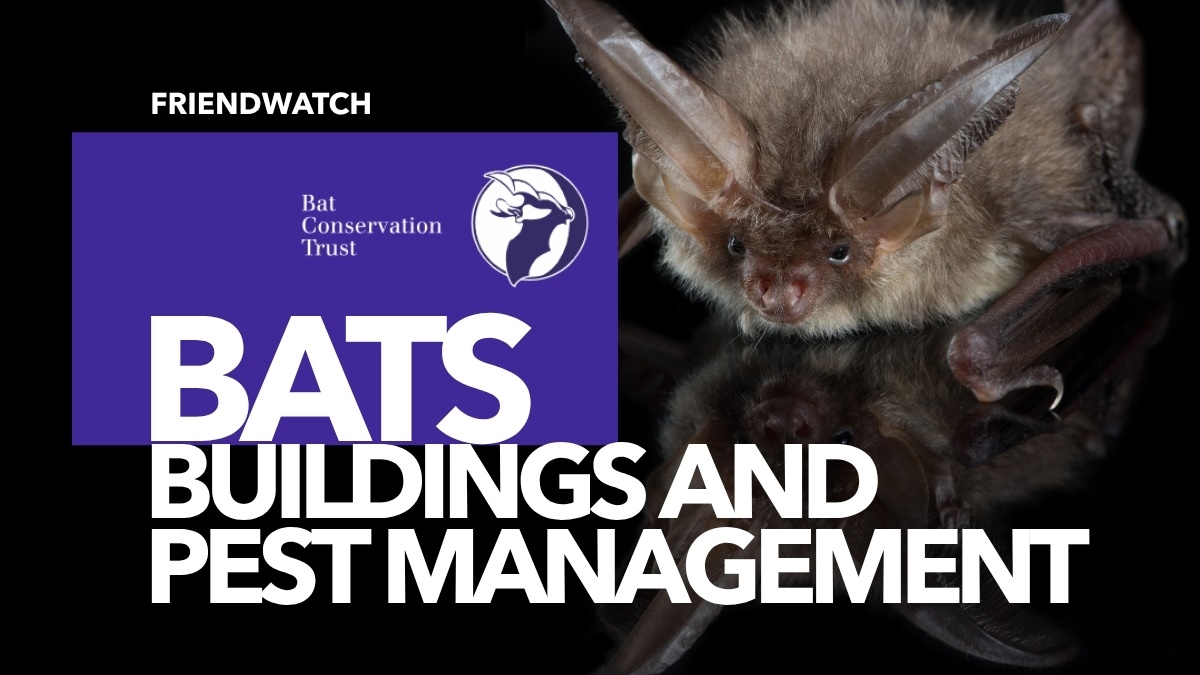
Emma Turnbull, Biodiversity Training Officer at the Bat Conservation Trust, explains why bats matter, how they use buildings, and what pest professionals need to consider when carrying out work where bats may be present.
Speed read
- The UK has 17 breeding bat species, and all of them have been recorded using buildings to some degree
- A bat roost is any place used by a bat for shelter, even when the bat is not present
- Roosts are protected by law, whether or not bats are there at the time
- Bats are particularly vulnerable during maternity season and hibernation
- Pest control work can risk disturbing bats, blocking access points, or exposing bats to harmful chemicals
- Timing, localised treatment, bat-friendly methods and professional advice can help work go ahead safely and legally
- Sticky traps, fly papers and some pest control treatments can present serious risks to bats.
Why bats matter
The Bat Conservation Trust is the leading non-governmental organisation in the UK solely devoted to conserving bats and the landscapes they rely on. One of those landscapes is the built environment.
That is where pest professionals come in.
If you are working in roof spaces, lofts, wall cavities, old buildings, houses, offices or commercial premises, there is a real chance you may come across bats or bat roosts.
And because bats and their roosts are protected, it is important to know what you are looking at before work begins.
A brief introduction to British bats
Bats are mammals, and they are the only true flying mammals.
Worldwide, we know of more than 1,500 species, and new ones are still being discovered. Around the world, bats vary hugely in size and diet. They may eat insects, pollen, nectar, fruit, and even other bats and birds.
There are three species of vampire bat, but they are only found in South America, so they are not a problem for us here.
In the UK, we have 17 species of bats that breed here. All of our British bats are nocturnal, all eat insects, spiders and other invertebrates, and all hibernate during the winter.
They are also long-lived. Even some of our smallest bats can live for well over 10 years. The oldest bat ever recorded was a wild Brandt’s bat found in Siberia. It had been ringed by researchers in 1964 and was recaptured in 2005, making it at least 41 years old. For a tiny mammal weighing just a few grams, that is extraordinary.
Our bats only have one young per year. That makes them especially vulnerable to population decline, because numbers cannot recover quickly if roosts or foraging areas are lost.
What is a bat roost?
A bat roost is any place used by a bat for shelter. Importantly, it is still classed as a roost even when the bat is not present.
Bats do not build nests. They do not collect nesting materials or chew things up to create a nest. Instead, they hang up or creep into a crack or crevice.
That means ordinary buildings, roof spaces, gaps, soffits, fascia boards, cavity walls and other small features can all become important.
Some bats, such as brown long-eared bats and greater horseshoe bats, may roost in loft spaces, hanging from the underside of roof lining. Others, such as pipistrelles, may tuck themselves behind lifted fascia boards or into cavity walls, accessing the building through gaps in mortar or under tiles.
It is worth remembering just how small a gap bats can use. A pipistrelle bat can get into a gap of around 10mm. They do not necessarily need to fly into a space; they can land next to an access point and crawl in.
That matters for pest professionals because many of the features used by bats can also be used by rodents, wasps or other pests.
I once carried out a survey on a property where, just as dusk was coming in, a swarm of wasps became very active around their entrance. Not long afterwards, pipistrelle bats started emerging from a gap slightly further along the roof. Once it was dark and we used infrared cameras, we could see the bats emerging nearer to the wasp nest.
My assumption was that the bats had annoyed the wasps before emerging.
Buildings can hold more than one story at once.
When bats use buildings
Bats may use buildings at any time of year, but they are often most obvious between June and August, when females form maternity colonies.
During the summer, bats fly out at night to feed on insects and return to the roost during the day. These roosts can be especially vulnerable because large numbers of bats may be gathered together, and the young may be unable to fly.
A maternity roost of soprano pipistrelles can include hundreds of bats, sometimes even a thousand or more. Young bats are completely dependent on their mothers. They suckle milk until they are weaned, which can take four to six weeks.
In some cases, all the females of a species in the surrounding area may gather in a single roost. Disturbing or damaging that roost could therefore affect the entire local population.
In winter, the requirements are different. Bats need somewhere cool, humid, stable and undisturbed for hibernation. They may be alone or in small scattered groups, hidden in crevices, under slates or deep in gaps in mortar.
During hibernation, bats are metabolising at a very low level. They may not produce droppings as obvious evidence, and they may be completely out of sight.
They are also extremely vulnerable to disturbance. If a hibernating bat is woken, it can take 30 to 40 minutes to fully come out of torpor, and the energy used may not be replaced because food sources are scarce or non-existent in the coldest months.
Signs of bats in buildings
One of the most common reasons I am asked to look in lofts is to identify droppings.
Bat droppings can sometimes be found in large numbers, depending on the species and the type of roost. A useful clue is that bat droppings crumble easily when squashed, because they are made up of insect fragments that cannot be digested. Rodent droppings do not squash in the same way.
The location of droppings can also help. A line of droppings under the ridge of a roof, for example, is often associated with brown long-eared bats.
You may also find feeding remains. Brown long-eared bats often use feeding perches where they hang up to eat moths. They discard the wings, so you may find piles of moth wings under a perch.
Outside the building, there may be droppings below an access point or staining where bats repeatedly enter and leave. Oils from their fur can leave marks on timber or around gaps.
If you find a large number of droppings in a loft during summer, it is sensible to assume bats may be present until you know otherwise. The best next step is to get advice, either from an ecologist or through the Bat Conservation Trust National Bat Helpline.
Bats are protected
Bat populations have decreased in both range and number, and that has dictated the level of protection they need.
Bats make up around a quarter of all UK mammal species. That surprises many people. If you ask someone to name a British mammal, they will probably say a deer, fox, badger or rabbit. But a 1/4 of our mammal species are bats.
In simple terms, it is an offence to deliberately capture, injure or kill bats. It is also an offence to deliberately disturb bats in a way that would affect their ability to survive, hibernate, breed or rear young, or significantly affect their local distribution or abundance.
That could include waking bats during hibernation, disturbing a maternity colony, entombing bats, or carrying out work during the breeding period.
It is also an offence to damage or destroy a breeding site or resting place. In other words, a roost.
This is really important: a known roost is protected whether bats are present at the time or not.
Under the Wildlife and Countryside Act 1981, as amended, it is also an offence to intentionally or recklessly obstruct access to a bat roost or disturb a bat at a roost.
So, for example, you cannot simply block up a known roost entrance, even if you do not see bats there that day.
What pest professionals need to consider
When pest control work may affect a roost, the key is to risk assess the situation and look for ways to reduce the likelihood of harm or an offence being committed.
Depending on the work required, a licence may be needed. This would be granted by the relevant regional Statutory Nature Conservation Organisation; Natural England, Natural Resources Wales, NatureScot or the Northern Ireland Environment Agency, depending on where the work is taking place.
Whether a licence is required will depend on the extent of the work and the outcome of surveys carried out by an ecologist.
In some cases, work may be able to go ahead without a licence, but still under supervision of an ecologist, particularly if disturbance can be avoided, access is retained, and the work is done when bats are absent.
In other cases, especially where bats may be disturbed, or a roost site or access point will be lost, a licence is likely to be needed. The licence application will be produced by the ecologist and include mitigation, compensation and monitoring methods.
For pest control, a major risk is the use of chemical treatments, including insecticides and rodenticides, which bats may come into contact with. Bats groom themselves regularly, so if a harmful substance gets onto their fur, they are likely to ingest it.
The best way to reduce that risk is often to carry out work when bats are absent from the roost. We may also advise localised application, wiping up excess or spillages, and avoiding treatments that could expose bats unnecessarily.
Blocking access is another risk. Many pest entry points are at ground level, but where gaps are higher up, there is a possibility that you could block the entrance bats are using to access a roost.
If there is any doubt, an ecologist or volunteer roost visitor can help identify access points.
Disturbance is also important. There are times of year when bats are especially vulnerable, so timing matters. For example, it may be better to place enclosed bait traps outside maternity and hibernation periods. Even if the traps themselves are unlikely to contact bats, the repeated checking and replacing of traps could disturb the roost.
Sometimes the solution is about adjusting the schedule and increasing gaps between visits, reducing the need to disturb the area.
There are usually workarounds. The important thing is to think about bats before work starts, rather than discovering the problem halfway through.
Or, to put it more simply: time it right, and get someone to confirm it if you are not sure.
Sticky traps and fly papers
Sticky traps are a serious issue for bats.
As a bat carer, I have had bats brought to me stuck to insect traps and fly paper. The worst case I dealt with was a brown long-eared bat caught in a triangular insect trap.
I did manage to release it using olive oil, but it was stressful and time-consuming, and this sort of situation is often fatal.
To reduce the risk, sticky traps should be avoided where bats may come into contact with them. If they have to be used, think very carefully about placement. Covering them with a cage with gaps too small for bats to enter or placing them at floor level can reduce access by bats.
For cluster fly issues, it is worth looking for bat-friendly trap options, such as partially enclosed traps.
If fly paper is being considered, one possible workaround is to place it inside a bird feeder so bats cannot reach the sticky paper.
The main principle is simple: avoid control methods that put bats at risk.
What about disease?
Questions about bats and disease often come up, especially since Covid.
It is important to understand that British bats are very different from some bat populations elsewhere in the world. The species, ecology, scale, proximity to people and wider circumstances are not the same.
There is a lot of research in this area, and it is not something that can be neatly summed up in a couple of lines.
The notable disease concern in the UK is European bat lyssavirus, which is a type of rabies. In the UK, only two of our 17 breeding species have been found to carry the virus: Daubenton’s bats and serotine bats.
The risk to people is very low, and fluid-to-fluid contact is needed. In practical terms, the risk would be if you were bitten or scratched by a bat.
Pest professionals should not be handling bats. Bat carers wear gloves, are vaccinated and follow established procedures. If someone is bitten or scratched by a bat, they should seek medical advice because post-exposure treatment may be needed.
British bats do not deserve to be feared, but they do need to be treated with respect.
Final thoughts
Bats are part of our built environment.
For pest professionals, the key message is bats do not stop work from happening. We just need to understand where they may be, how they use buildings, and what the law requires to protect the bats from harm and people from committing an offence.
In many cases, with good timing, sensible precautions and the right advice, work can go ahead while still protecting bats and their roosts.
The best approach is to pause, look for evidence, consider the season, assess the risks, and ask for advice where needed.
Bats are fascinating animals; they are important indicators of environmental health, and they are a major part of our native mammal fauna.
And honestly, once you start learning about them, they really do become addictive.
Useful resources
Watch the full session
This article is based on Emma’s BPCA Digital Forum talk on bats in buildings, which is available to watch back on BPCA’s YouTube channel.
Watch the full talk on BPCA’s YouTube channel for more detail on bat roosts, legal protection, pest control risks and practical ways to work around bats safely.
Watch now