RESEARCH
In July, BPCA launched a survey looking at your experience of using working dogs in pest management. Here’s what we learned.
BPCA is committed to protecting the pest management toolkit, of which working dogs are an important part. As we see potential changes in the law, the experiences you share with us are valuable evidence that helps us represent the sector.
Towards the end of July, we launched a survey to hear about your experiences using working dogs in pest management.
The survey and its results not only help us understand you and your work, but are also valuable as we lobby to protect the pest management toolkit.
We have already used your feedback to help inform our response to proposed legislation in Northern Ireland, the only part of the UK where hunting with dogs is currently unrestricted.
The proposed legislation would seek to bring Northern Ireland more closely in line with the rest of the UK and is largely modelled on Scotland’s law.
The Northern Ireland Assembly’s Committee for Agriculture, Environment and Rural Affairs issued a call for evidence on the Bill, to which BPCA responded. We expect to provide further evidence as the legislation progresses, and your responses to the survey will help us demonstrate how working dogs are used in professional pest management.
What we learned
As the law around the use of working dogs has changed in recent years, and may change further in Northern Ireland, England and Wales, the survey looked closely at how existing laws meet the realities of pest management work.
Different questions were asked depending on where respondents operate, allowing us to better understand how the different laws affect pest professionals across the UK.
Where respondents operate
Of those using working dogs in pest management:
| Country |
Respondents |
| England |
81% |
| Scotland |
14% |
| Northern Ireland |
3% |
| Wales |
2% |
How are dogs being used?
Dogs were mostly being used to support the control of mammals.
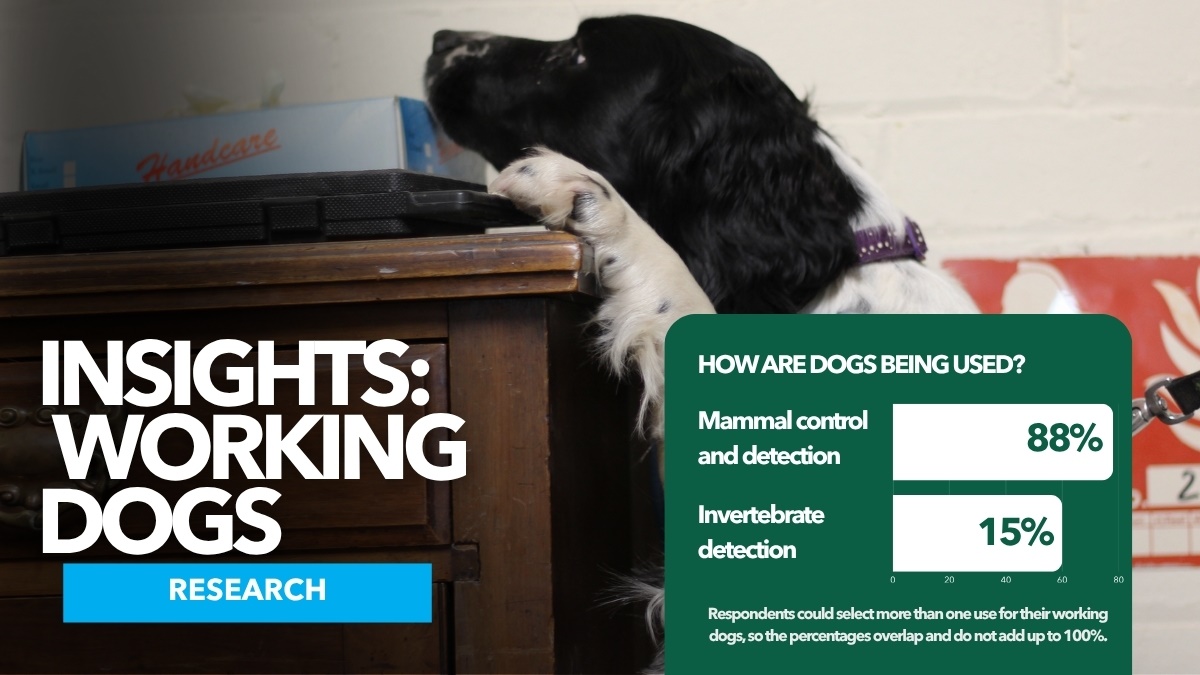
Some 88% of respondents who used working dogs did so when controlling mammals, compared with 15% who used dogs in work involving invertebrates.
| Use of working dogs |
Respondents |
| Mammal control and detection |
88% |
| Invertebrate detection |
15% |
Respondents could select more than one use for their working dogs, so the percentages overlap and do not add up to 100%.
The only invertebrate respondents reported training dogs to detect was the bed bug.
Half of the respondents using dogs for bed bug detection had trained the dog themselves.
That proportion was much higher for dogs trained to detect mammals, with 82% of respondents saying they had trained their own dogs.
Which mammals are dogs trained to detect?
Rats were comfortably the most common mammal that respondents trained dogs to detect.
| Mammal |
Respondents training dogs to detect them |
| Rats |
92% |
| Mice |
54% |
| Other mammals, including rabbits |
30% |
Respondents could select more than one use for their working dogs, so the percentages overlap and do not add up to 100%.
The way dogs are used for rabbits was particularly interesting.
Respondents described using dogs as part of the survey process much like they do for rodents, keeping them above ground and using their sense of smell to establish whether a burrow was being used as harbourage.
This could save time during surveys and allow pest professionals to implement appropriate controls more efficiently.
It’s a useful example of why understanding how working dogs are actually used matters when legislation is being considered. Dogs may form part of surveying and detection work as well as direct control activities.
Why your evidence matters
We’re grateful to everyone who gave their time to complete the survey.
The knowledge and experiences you share with us provide evidence that helps BPCA explain to policymakers how pest management works in practice.
This is particularly important when legislation could affect tools or techniques used by professional pest controllers. Good evidence helps us show where working dogs fit into pest management, what they are being used for and what the consequences of changes to legislation might be.
Working dogs are part of the wider pest management toolkit, and we want to make sure decisions about their future use are informed by the experiences of the professionals who rely on them.
If you have any more thoughts you would like to share with us about the use of working dogs in pest management, email policy@bpca.org.uk.