PPC123 | TECHNICAL
Professor Seirian Sumner, University College London, studies wasps for a living. In this article, she explains why pest professionals are uniquely positioned to help society think differently about wasps, without pretending that every nest in every loft should be left exactly where it is.
I should probably start by admitting that PestEx 2026 may have been the most difficult audience I will ever speak to about wasps.
I’m used to giving popular science talks to members of the public about why wasps matter. I’m a behavioural ecologist at University College London, and I study wasps for a living. My life is as entwined with wasps as yours is, although perhaps from a rather different angle.
You deal with wasps when they are in people’s lofts, sheds, walls and gardens. I deal with them because I think they are beautiful, fascinating and important. Somewhere between those two worlds, I think there is a conversation worth having.
I am not here to pretend that there aren’t wasp nests that need ‘management’. Nobody likes a wasp nest in the wrong place. Some people are frightened. Some are at risk. Some nests are simply not compatible with people safely using a building.
But I do want to ask whether we can be more wasp-positive. Not wasp-naive. Wasp-positive.
The gangsters of the insect world
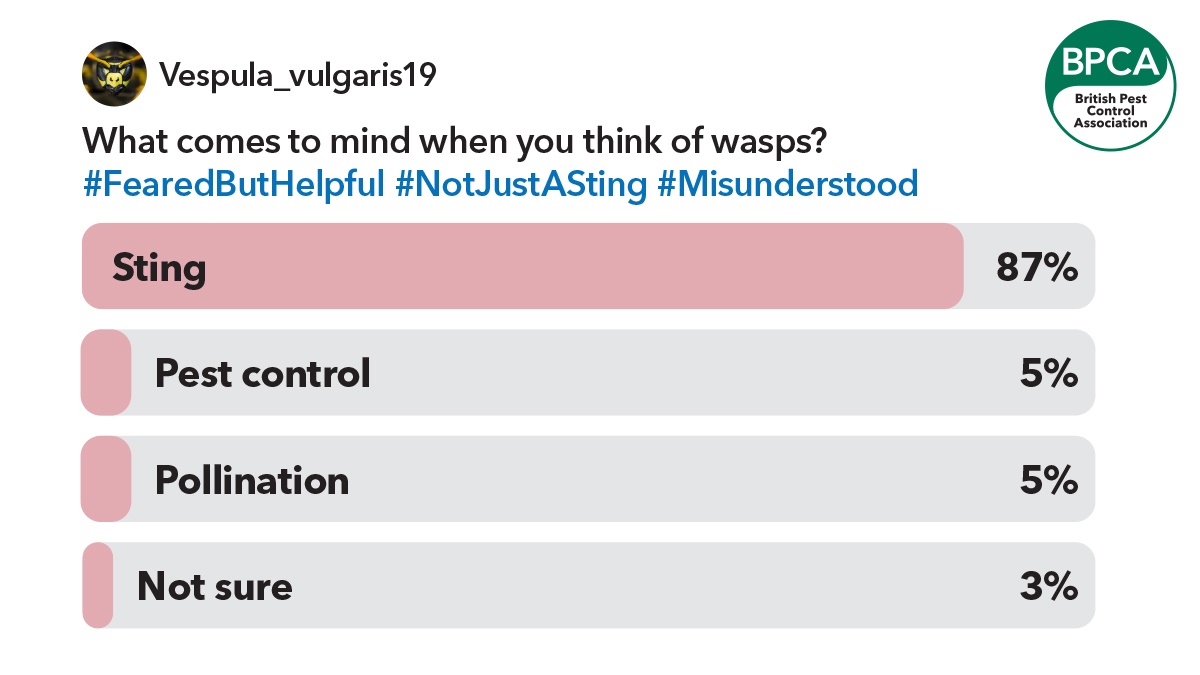
The common yellowjacket wasp is no stranger to pest controllers. You are, in fact, a privileged sector of society, because you get to see these animals close up. Most people do not. Most people see a wasp and think one word: sting.
A few years ago, we asked members of the public what words came to mind when they thought about wasps. The dominant word was, unsurprisingly, sting. Fair play. Wasps do sting.
But then we asked the same question about bees. Bees sting too, of course, but the words people used were very different. Honey. Flowers. Pollination. Nature. The word sting was used, but much less frequently.
That difference matters; people tolerate bee stings because they understand what bees do. They know bees matter. They have a story for bees. Wasps have not been given the chance to tell their story. They are viewed as the gangsters of the insect world. They inspire bad language, terrible horror films and a general sense that the world would be better off without them. I don’t think that is fair. More importantly, I don’t think it is ecologically sensible.
We need to talk about the Asian hornet
Before I get too carried away with the wasp positivity, I do need to temper the story slightly. The yellow-legged (Asian) hornet (Vespa velutina) is a very real concern. It is an invasive species. It can outcompete native predators and causes particular concern for beekeepers.
Until very recently, Defra had done a good job keeping it under control in the UK. So, let’s be clear. Native wasps and invasive wasps are not the same conversation. When organisms are outside their native range and causing harm, they may need to be controlled.
But we should not let our concern about invasive species become a blanket hatred of all wasps.
My gateway wasps
I’ve been studying wasps for more than 25 years. I have travelled the world to find fun wasps, although I confess that until the pandemic forced me to stay at home, I did not study British wasps very much.
If you want to enter the wasp-positive world, Southeast Asian wasps are fabulous beginner wasps. They led me on to larger, scarier and more spectacular wasps around the world.
But I’ve realised something in recent years. Most people do not necessarily care about the social behaviour of wasps. What they really care about is what wasps do for them. So, here are four reasons to care.
Wasps are pollinators
Adult social wasps hunt prey, but they do not eat the meat themselves. The prey goes to the larvae in the nest. The adults are, essentially, vegetarian. They need sugar, and they get it from flowers, ivy, fruit and, yes, sometimes your drink at a barbecue.
When wasps visit flowers, they can pick up pollen and move it from one flower to another. That makes them pollinators.
This is massively understudied compared with bees, but the evidence is there. We know that yellowjackets and hornets visit a huge diversity of plants. We know that common wasps visit ivy, which is an important autumn food source for other pollinators. If you care about bees having enough nectar and pollen, you should also care about the pollination of ivy.
Wasps may not look as fluffy as bees, but they are hairier than people realise. They also carry electrostatic charge, which can help pollen stick to them. They have many of the traits we associate with pollinators. We just haven’t given wasp pollination the scientific attention it deserves.
Wasps are food and medicine
Hands up, who has eaten a wasp? Usually, not many hands go up in Britain. You are missing out.
In parts of Japan, giant Asian hornet larvae and pupae are a delicacy. I spent time with hornet hunters there. They lure a worker in with bait, tie a ribbon to her, then follow her as she flies back to the colony. Over a few hours, they track the nest, dig it up and relocate it into a hive.
Then they rear the colony before harvesting the brood for human consumption. One wasp keeper proudly showed me his wasp larvae for sale in the local supermarket. Japan even has an annual wasp festival. Wasp keepers bring along their best wasp nests in the same way we might bring prize cucumbers to a garden show. The biggest nest wins.
In Nagaland, in north-east India, wasps are not just a delicacy. They are part of life. People farm giant Asian hornets because they are part of their culture and food security. They know the ecology of these insects in astonishing detail. They know where queens are likely to be. They know how to move colonies. They know which species tastes best.
There are also medicinal dimensions. Wasp venom, symbionts and compounds associated with wasps are being studied for antibiotics, antivirals and even cancer treatments.
In the West, we are mostly unaware of this. In other parts of the world, people have a very different relationship with wasps; and we have a lot to learn from them.
Wasps are culturally important
In Cameroon, we have been working with subsistence farmers to understand what they know about wasps and whether wasps might help them control crop pests.
There, we found social wasps living on houses and even inside houses. I remember standing in somebody’s lounge, wearing Marigolds and a bee hat, taking down a nest so we could sequence the wasps.
The people in the house said, “You can have those two nests, but leave that one for me.”
Over the sofa. Over the bed. They wanted to keep it. Why? Because to them, wasps are guardians of the house. They protect against evil spirits. They sting you if you “have a bad mind”. They protect against disease. They “cure stomach aches”.
Whether you share those beliefs or not, the point is that in some cultures, wasps are not automatically seen as enemies. The relationships of people who live very different lives to us, remind us how disconnected from nature we have become. I think we’re missing a trick.
“People tolerate bee stings because they understand what bees do. They know bees matter. They have a story for bees.”
Wasps are nature’s pest controllers
If there is one thing I want you to remember, it is this: wasps regulate other insect populations.Take wasps away, and other insect populations can explode. Flies, beetles, caterpillars and other arthropods all become more abundant when you remove the top ‘apex’ predators.
Solitary wasps do this in wonderfully gruesome ways. One of my favourites is the jewel wasp. She stings a cockroach twice. The first sting slows it down, enabling her to administer the second sting, which she uses to inject neurotoxins into the zombie-cockroach’s brain. The cockroach is still alive, but has no free will. She then walks it to her burrow, lays an egg on it, seals up the burrow and leaves her larva to eat its way through a perfectly preserved, paralysed living larder.
And then there’s Pepsis, a huge spider-hunting wasp we caught in the Amazon rainforest. She had just caught an enormous spider, which she had paralysed with venom. Had we not caught her for research, she would have buried that spider, laid an egg on it, and her baby would have feasted on its paralysed body.
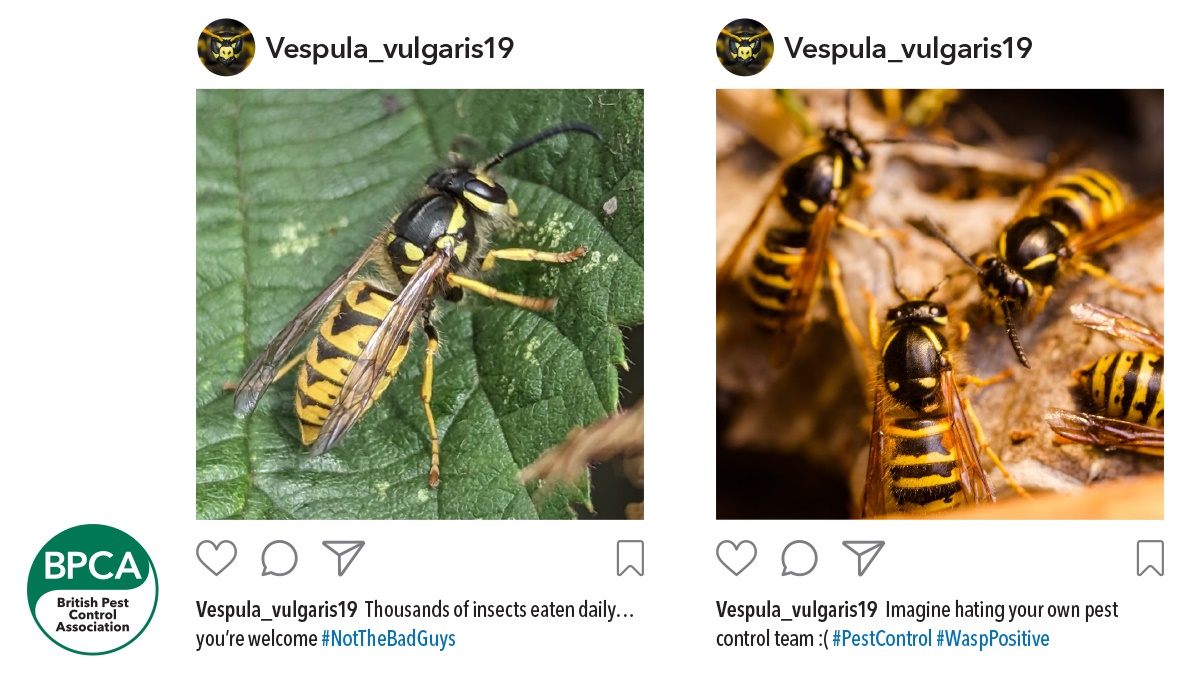
Social wasps are different. They are generalist predators, meaning they hunt a diversity of prey. A colony of yellowjackets may have thousands of workers hunting around the landscape. They take flies, caterpillars, beetles, spiders and many other arthropods.
We have studied the guts of common wasp larvae from colonies in southern England. The gut contains the remains of what it has been fed. By sequencing the DNA in those guts, we can see what the colony has been hunting.
The answer is: a huge diversity of insects.That is why wasps have real potential as biocontrol agents. In Brazil, our work on social wasps has shown that they hunt major crop pests, including fall armyworm and sugarcane borer. They do not remove every pest, but they reduce pest numbers, reduce damage and help keep populations manageable.
In other words, wasps are pest controllers – like you. Just with wings.
Where do [human] pest controllers fit in?
What is the pest controller’s role in a wasp-positive future? I think there are three opportunities.
The first is relocation. I know that sounds radical, but it is not crazy. People relocate wasp nests in Asia every day – take the examples above from Japan and India. There are a few wasp conservationists in Europe doing it, but most relevantly, pest controllers in the United States are doing it.
Wasps use visual landmarks to find their nests, so if you move a nest only a short distance, the workers may return to the original site. But if you move it a few kilometres away, they reorientate to the new location. You may lose some workers, but if the colony is big enough, it should survive.
Yes, nests are fragile. But wasps rebuild. If the comb structure is damaged, we can separate sections, and they will repaper the envelope. They are remarkably resilient animals. As for aggression, your SodaStream is your friend.
Carbon dioxide can knock wasps down or make them dopey enough to handle. We use it in our research collections. A few pest controllers I know have tried it out, and the reports are encouraging. It is a means by which you can safely relocate a wasp nest, without using chemicals and minimising the risk of stings to you and those around you.
The second opportunity is communication. Pest controllers have access to people that scientists often do not. You go into homes and businesses when people are dealing with the animal. You are trusted to explain risk, options and action. That gives you power.
You can say, “This nest is in a risky place and needs managing.” But you can also say, “This one is not causing a problem. It will die out naturally in the autumn; and meanwhile it is your nature-friendly pest controller, eating flies and caterpillars in your garden.” That conversation can change how people think.
The third opportunity is collaboration. Scientists need live wasp nests. We are setting up “smart” wasp nests at UCL East to study sound, vibration, visual signals and communication. We need nests for our experiments, gene expression studies and work on parasites that may help control invasive yellowjackets in New Zealand. You get the calls.
We need the nests.
A more useful future for wasps
I am not asking pest controllers to stop managing wasps. That would be unrealistic and, in some cases, unsafe. I am asking whether we can think a little differently.
Could some nests be left alone? Could some be relocated? Could pest controllers become communicators, explaining that wasps are not just stings with wings? Could you become collaborators, helping scientists understand these animals better? That is where your expertise matters.
A wasp-positive future does not mean ignoring risk. It means recognising value, making informed decisions and helping the public move beyond one word: sting.
If you are interested in collaborating with our wasp lab at UCL or come across a wasp nest that you think can be easily relocated without the use of chemicals (or used for our research), please email Seirian at s.sumner@ucl.ac.uk. Read more about the secret world of wasps in Seirian’s popular science book, Endless Forms: Why You Should Love Wasps (William Collins).