PPC123 | TECHNICAL
Nicholas Donnithorne FLS FRES, UK Technical Manager at Rentokil Property Care, has worked with wood-boring insects, fungi, damp and timber treatment since 1980. Nicholas talks through the basics pest professionals need to know about woodworm, frass, flight holes and the species that can easily be mistaken for timber pests.
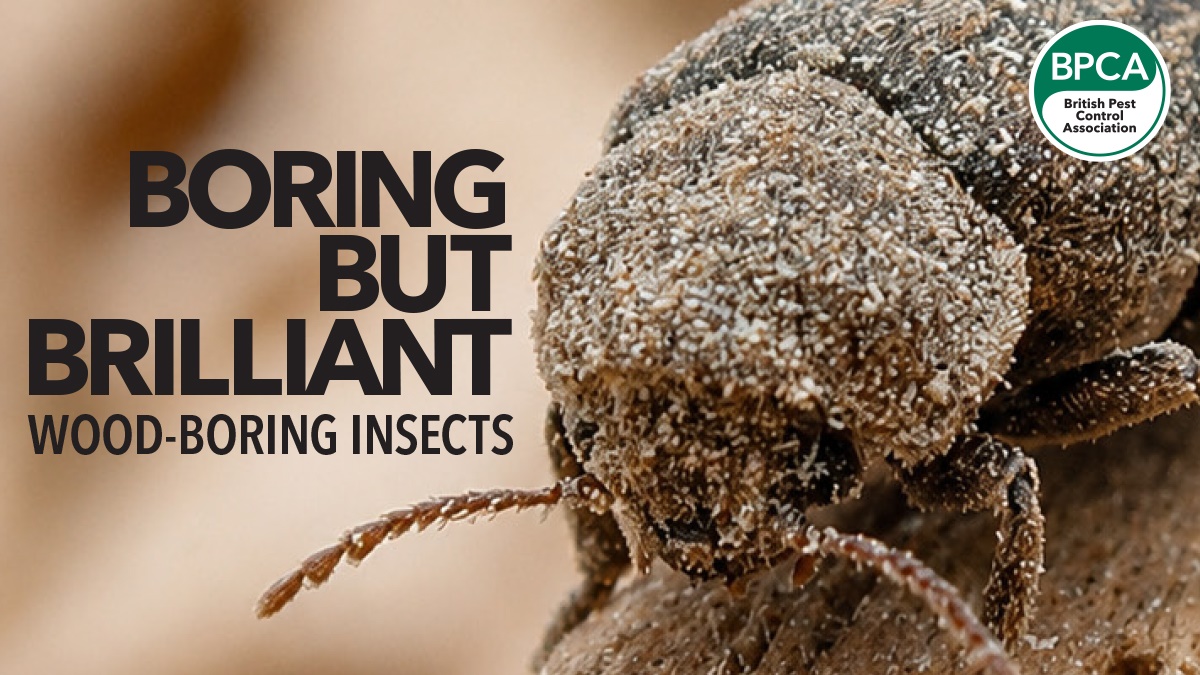
I know wood-boring insects may not be the first thing most pest professionals deal with day to day. Usually, specialist property care technicians deal with them. But you will get asked about them. Someone will find holes in a floorboard, beetles on a windowsill, or a load of dusty material under a piece of timber, and they will want to know whether the building is being eaten. So, let’s start with the basics.
Heartwood and sapwood
With wood-boring insects, you need to understand heartwood and sapwood. Generally speaking, both insects and fungi are interested in the nice, delicious, nutritious sapwood. They’re not interested in heartwood in the same way. Heartwood is full of rubbish from the tree, resins and that sort of thing.
It takes around 15 to 20 years to form heartwood in timber. So if you’re felling trees at 20 or 25 years old, they will mostly be sapwood. That means they can be eaten by wood-boring insects and decayed by wood-rotting fungi. If you want a quick return on your forest investment, and you’re growing timber for something like a child’s bunkbed ladder, you don’t need large-section timbers. So you grow it as fast as you can, using fast-grown trees such as Spruce, Radiata pine, or Paulownia.
You can see the proof of the pudding in attacked timber. You may find heartwood sitting in the centre, with decay and insect damage around the outside in the sapwood band. The insects haven’t gone boring outside that sapwood band because that’s where the nutrition is. If the timber has also become wet, all the better, as wood-boring beetle larvae get their water through the wood they eat.
Most modern houses are built out of conifers, known as softwoods. Older properties, especially timber-framed buildings, may have hardwoods such as oak. That matters because different insects prefer different timbers.
I keep breeding colonies of some wood-boring insects. One of my deathwatch beetle colonies was supported on fresh little oak sapwood blocks. The beetles moved out of the old, infested timber and into the fresh blocks because they knew perfectly well which bit was better food.
Where does woodworm come from?
The term woodworm refers to the larvae of any wood-boring beetle. When people ring up, they’re usually talking about common furniture beetle, but there are several species we need to think about.
The common ones are:
| Species |
What to remember |
| Common furniture beetle (Anobium punctatum) |
The commonest one you are likely to come across in UK properties. |
| Deathwatch beetle (Xestobium rufovillosum) |
Usually associated with decayed hardwoods, especially oak. Adults tap to attract a mate. |
| House longhorn beetle (Hylotrupes bajulus) |
Mainly found in north-west Surrey into Berkshire. Attacks softwood sapwood. |
| Powderpost beetle (Lyctus brunneus) |
Attacks wide-pored hardwood sapwood with high starch content. |
| Wood-boring weevils (Pentarthrum huttoni, Euophryum confine and Euophryum rufum) |
Need damp, decayed timber. Damage is secondary to fungal decay. |
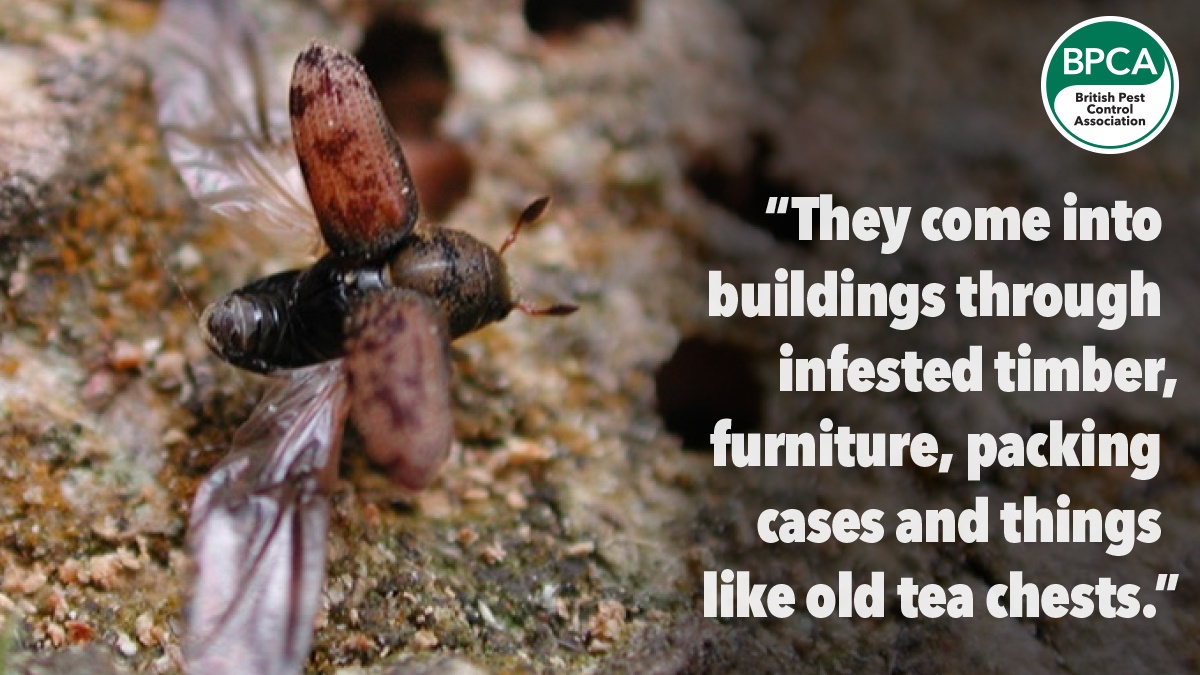
These insects are out there in the natural environment. They can fly or crawl into a property, but normally come into buildings through infested timber, furniture, packing cases and things like the old tea chests people used to put in their lofts after they moved.
If you’re in a terrace and number one has a really good common furniture beetle attack in the loft, it can slowly progress along.
The life cycle
Common furniture beetle has a life cycle of around three to five years, all inside a piece of wood. There’s nothing on the surface for us to get to easily.
Most of these beetles emerge somewhere between April and September. If you’re finding lots of beetles outside that period, they’re unlikely to be wood-borers.
The female lays eggs randomly, trying to push them into a crack or something similar. After about four weeks they hatch, and the little larva bores down through the egg case into the wood if it can.
Why does it eat the egg case? Because these beetles have somehow got to get nutrition out of wood fibre. They rasp off a bit of wood fibre, put it in their mouth, and it goes down their gut. The enzymes in the gut extract the nutrition. Those enzymes come from their mother and her mother before her. When she lays the eggs, she gets a bit of enzyme over the egg case. The larva eats the egg case and picks it up.
Then it wiggles around inside the timber, munching as it goes. You’re not going to see it.
When it is ready to emerge, it forms a pupal chamber near the surface. The pupal chamber is clear inside to give space for the pupa to form. No frass, no poop. People think frass falls out of flight holes because it has come out of the pupal chamber. It is usually caused by beetles or larvae moving in the tunnels behind a flight hole.
The adult pops out of the pupal case, munches away the last thin veneer of timber above its head and emerges. As most of the British wood-borers are concerned, that’s the only time the adult munches wood. They’re not taking it in for nutrients.
Then they run around, look for a mate, mate, lay eggs and drop dead. The only exception in the common species is wood-boring weevil, where both the larva and the adult eat decayed wood.
Moisture matters
Wood-boring larvae need water and nutrition from dry timber. That is not easy.
Laboratory research shows eggs won’t hatch between 8% and 12% moisture content. Your average heated house is around 9%, so it’s on the cusp. A normal cool house is around 15%.
But the beetles are not usually in the middle of a lovely, dry living room. They are under subfloors, in damp timbers, or where there has been a leak.
In one case I remember, there was nothing in the big beam, but the timber block built into the wall, which was getting damp, was completely riddled. Another was a leaking bath. A nice little drip, drip, drip every now and then, and the floorboard had completely disintegrated.
Frass is useful
Woodworm frass, for want of a better word, is their poop. It’s perfectly safe to handle. Pick it up in your fingers, rub it between your thumb and forefinger, and have a look under a hand lens.
If it is gritty and lemon-shaped, you’ve got common furniture beetle frass.
All those wood fibres pass down the gut, are packaged at the rear end and pooped out. From the shape, you can tell what species is inside the wood. Some material is torn off but not eaten, and that is called rejectamenta. Most of it is excrementa. Different species produce different frass.
House longhorn beetle produces nice, big sausage-shaped pellets. Powderpost beetle produces very fine, talc-like material.
If someone tells you they have larvae crawling on the surface of the wood, be careful. In your line of work, if you’ve got larvae crawling over a piece of wood, unless it’s deathwatch beetle at the right time of year, I’d suggest having a better look, it is probably the larva of a stored product beetle, moth or fly.
Deathwatch beetle is the exception that proves the rule. When newly hatched, if it can’t get down into a crevice in the oak, it may go wandering. It’s covered in very fine hairs and can roll itself along the surface until it finds somewhere to go in, such as an old flight hole or crevice.
Common furniture beetle
Common furniture beetle is the one you are most likely to come across. It accounts for the bulk of woodworm problems in UK homes.
It’s a dark chocolate-brown insect. The head is tucked under the pronotum.
It attacks softwoods and the sapwood of European hardwoods. It also likes plywood. Think about how plywood is made. You take a log, boil it or soak it, put it on a lathe, introduce a very sharp blade, and the ply comes off in a long thin sheet. You glue it together in layers and get plywood.
That is a product you want to grow as fast as possible to get your money back, so it is mostly sapwood. Therefore, it is mostly food for wood-boring beetles.
Wickerwork is another one. Wicker baskets, particularly laundry baskets in bathrooms, are well worth looking at.
Common furniture beetle is often confused with biscuit beetle. Biscuit beetle is ruddy brown, whereas common furniture beetle is darker chocolate brown. Biscuit beetles are also often found outside the woodworm flight season and in large numbers.
So don’t just see a small brown beetle and assume timber treatment.
Deathwatch beetle
Deathwatch beetle is a much bigger, hairier beetle. For those of you as old as me, it has lovely Des Lynam hair, little pale patches here and there.
You’ll normally find these in hardwoods, especially oak, and usually where there has already been some decay. They prefer European hardwoods, especially oak, ash and chestnut softened by partial decay, and may rarely attack softwoods if in contact with infested hardwoods. The famous thing about deathwatch beetle is the tapping.areas. They wander around in dark areas, often dark bits of timber up in lofts, and they need to communicate. Most insects use pheromones. Deathwatch beetles decided they wanted to get into handbanging as well, a bit like Status Quo but an awful lot faster.
They come up on the front, come up on the rear and whack the head down on the frons. The impact rate can be around 10 beats per second, usually 13 beats in each burst.
If you’ve got a property with deathwatch beetle and you’re in bed at night, it is quite noisy. Brilliant, unless your house is infested with it, in which case you just want it to go away.
Other beetles and the things that are not woodworm
House longhorn beetle is a large beetle, around 20mm, with long antennae. In the UK, it is mainly found from north-west Surrey into Berkshire. It attacks softwood sapwood and, these days, I most often see it in imported timber.
Forest longhorn beetles are different. There are thousands of longhorn beetle species worldwide, and more than 100 in the UK, so a photograph of “a longhorn” is not always enough. Often the source is firewood brought in for winter. If beetles emerge in spring, they may look dramatic, but they are not necessarily going to attack the property.
Powderpost beetle usually comes from hardwoods that have not been properly seasoned. It needs high-starch sapwood from wide-pored hardwoods and can turn over sapwood quickly. Most are coming into the UK in imported finished products.
Wood-boring weevils need damp, decayed timber. If they could eat dry, solid timber, they would probably be the commonest wood-borer in the UK. They can’t. They need timber already affected by fungal decay.
Pest professionals will also get calls about insects that are not wood-borers at all. Ash bark beetle can emerge from ash logs. Hide beetle can make shallow pupation chambers in timber after feeding on dead material, such as a pigeon in a loft. Brown tree ants can turn up in damp areas, insulation boards and underfloor heating, causing people to worry about termites or carpenter ants.
Surveying
Surveying is mostly similar to what pest professionals already do; except this time you’re looking at bits of wood.
Most woodworm are flying beetles, so they can be found anywhere there is wood. Look where beetles can gain access and where they may have been brought in.
Carpets and floor coverings inhibit flight, which is why boards should be lifted to check for activity. Be careful with timber or vinyl laminate because it can hide a heavy existing infestation.
Look at stored wood items in roof spaces, especially wicker baskets and logs by fireplaces.
You should be asking:
- What species is it?
- What is the degree of infestation?
- Are the holes clean?
- Is there frass?
- Are there larvae?
- Are there dead or live beetles?
- Are there tapping sounds?
- Are there holes in underlays?
- Are there signs of previous treatment?
Use a probe or hammer to establish the soundness of the timber and whether treatment is needed. A floorboard might only show a few holes on the surface, but if you cut into it, you may find quite a lot of damage inside.
Treatment basics
These days, we are usually left with spraying the surface of timber using a water-based preservative containing permethrin or borates.
Borates can diffuse through damp timber where conditions allow, whereas many water-based preservatives do not penetrate very deeply. With those, you are often treating around the outside and waiting for the insect to emerge and ingest a toxic dose.
The spray method is not like pest control spraying. We are not using fan sprays, high pressure or trying to drift a fine film over a surface. We use a coarse-cone spray, preferably at low pressure, and coat the timber to near run-off.
For deathwatch beetle, supplementary treatments may include defrassing, exposing and treating timber, paste, injection to sapwood only, or timber replacement. For house longhorn, you may also need defrassing and timber strengthening.
Controlled atmosphere technology can be used on valuable items, such as antique furniture. Treatment takes around 30 days using carbon dioxide or nitrogen. We are asphyxiating the little devils.
For most pest professionals, the main point is not to become a timber specialist overnight. It is to know what you are looking at, know when it might not be woodworm, and know when to signpost to someone with the right training.
Because if you get the identification wrong, you can send the client down completely the wrong route.
Rentokil Property Care provides property preservation services to homes and businesses across the UK. They provide thorough damp and timber surveys and specialist treatments across the UK. rentokil.co.uk/property-care